How to Rank YouTube Videos on the First Page of Google: The 2026 Complete Guide

Optimizing video content to dominate Google and YouTube search results in 2026.
If you've ever wondered why some YouTube videos appear on the first page of Google while others receive very few views, the answer lies in YouTube SEO and Google Search optimization. Ranking your videos isn't just about uploading great content—it's about helping both YouTube and Google understand what your video is about and why it deserves to be shown to users.
In the digital landscape of 2026, the integration between search and video is tighter than ever. Google typically shows videos when they provide the best answer to a user's question. Tutorials, product reviews, and educational guides often perform the best in organic search results.
This guide provides practical, actionable strategies to improve your chances of ranking YouTube videos on Google's first page and attracting consistent organic traffic.
Introduction
How Google Ranks YouTube Videos
Keyword Research for YouTube SEO
Understand Search Intent
Write SEO-Friendly Video Titles
Optimize Video Descriptions
Use Tags and Hashtags Correctly
Create High-CTR Thumbnails
Increase Watch Time & Audience Retention
Boost Likes, Comments & Shares
Add Chapters & Closed Captions
Build Channel Authority
Common YouTube SEO Mistakes
Frequently Asked Questions
Conclusion
1. Choose the Right Keyword
Keyword research is the foundation of YouTube SEO. Instead of targeting broad terms, focus on specific search phrases that people actually type into Google. In 2026, Google’s AI prioritizes "Natural Language" queries.
Look for keywords with good search volume and moderate competition. Long-tail keywords (e.g., "how to rank YouTube videos on Google for beginners") are usually easier to rank for than short, highly competitive phrases.
Video SEO: 2020 vs. 2026
| Factor | Traditional SEO (2020) | Modern SEO (2026) |
|---|---|---|
| Primary Signal | Keywords & Tags | User Intent & Retention |
| Metadata | Keyword Stuffing | Contextual Descriptions |
| Discovery | Search Only | Google Lens & Suggested Clips |
| Navigation | Continuous Play | AI-Generated Chapters |
2. Create Content That Matches Search Intent
Google rewards content that satisfies users. Before creating a video, ask yourself: Will this video solve a real problem? Content that performs well on Google usually falls into these categories:
- Tutorials: "How to fix a leaky faucet."
- Reviews: "Best mirrorless cameras 2026."
- Comparisons: "iPhone vs. Samsung for Video."
- Educational: "How the YouTube algorithm works."
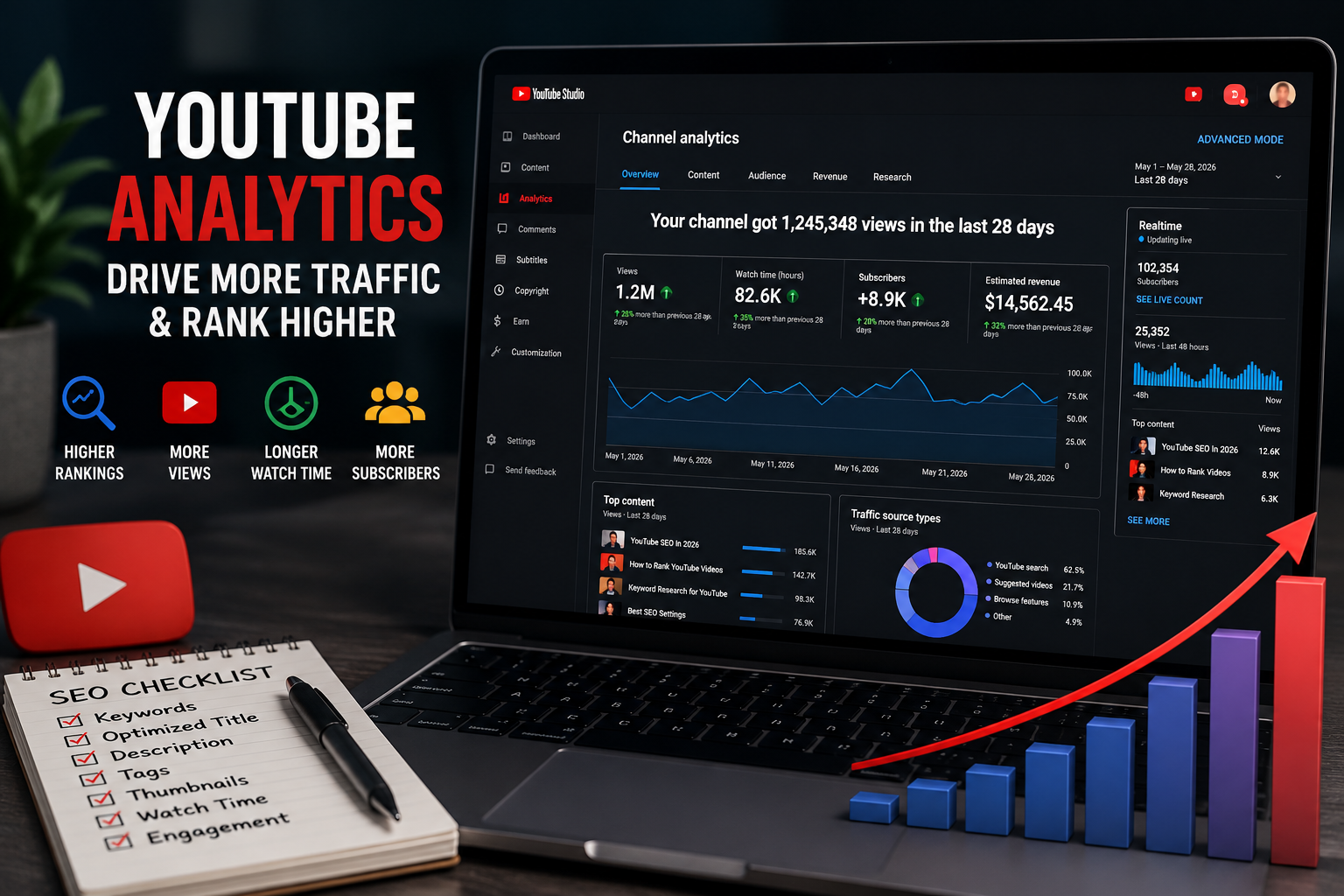
YouTube SEO analytics dashboard showing keyword rankings, watch time, audience growth, and organic traffic.
3. Write SEO-Friendly Titles and Descriptions
Your title should include your primary keyword naturally while remaining enticing. In 2026, click-bait is heavily penalized; instead, focus on clarity and curiosity.
The first few lines of your description are critical. Explain exactly what the viewer will learn and include a relevant CTA. Aim for 200+ words of detailed description to give search engines more context to crawl.
4. Design an Eye-Catching Thumbnail
Your thumbnail is your "billboard." A higher Click-Through Rate (CTR) signals to Google that your video is relevant. Use high-resolution images, contrasting colors, and readable text to stand out in the "Video" tab of Google Search.
5. Improve Audience Retention
One of the strongest ranking signals is how long viewers continue watching. If users click your video on Google but leave after 5 seconds, your ranking will quickly drop.
- The Hook: Start with a strong introduction that promises a solution.
- No Filler: Get to the point quickly.
- Visual Variety: Use B-roll, text overlays, and cuts to keep viewers engaged.
6. Add Chapters and Closed Captions
Video chapters help Google display "Key Moments" directly in the search results. This allows users to skip to the exact answer they need, which drastically increases your visibility.
Example Chapter Format:
00:00 Introduction
01:15 Keyword Research Tips
03:40 On-Page Optimization
7. Build Topic Authority
Consistently creating content around the same niche builds authority. A focused channel is easier for search engines to categorize. If you specialize in video production tools, make sure you cover every aspect of that topic to become a go-to source.
Frequently Asked Questions
How long does it take to rank a YouTube video on Google?
Some videos can rank within days if the keyword is low competition, while high-volume terms may take weeks or months to climb to the first page.
Does watch time affect Google rankings?
Yes. Google views high watch time and audience retention as indicators of quality. Videos that keep users on the platform are prioritized.
Are tags still important in 2026?
Tags play a minimal role compared to the title, description, and transcript. Focus on your first 200 words of the description instead.
Conclusion
Ranking YouTube videos on the first page of Google requires a blend of technical SEO and high-quality storytelling. By focusing on search intent, optimizing your metadata, and keeping your audience engaged, you can turn your YouTube channel into a powerful source of organic traffic.
The landscape of 2026 favors creators who provide immediate value. Treat every video as a long-term asset, and you'll build a presence that grows over time.
Boost Your Video Performance
Ready to take your content to the next level? Explore our YouTube Optimization Tools to streamline your workflow and dominate the search results today.